

Takeshi Obana
8-string guitarist Takeshi Obana

profile

Takeshi Obana 7-string and 8-string guitars
Born to a family that lived in Germany due to his father’s work, he spent his early childhood there. He began studying classical guitar at the age of eight and continued formal training even after returning to Japan at twelve.
During his teenage years, he became fascinated by the sound of distorted electric guitar and immersed himself in electric guitar playing. As a student, he rode the wave of the Japanese heavy metal boom, performing original compositions with a progressive hard rock band and playing extensively at rock venues in Tokyo and the Yokohama area.
Around the time of his university graduation, he encountered Brazilian music—an experience that led him back to the classical guitar as his main instrument. His initial gateway was the collaboration between American fusion musicians and Brazilian artists, which gradually drew him deeper into MPB, bossa nova, samba, and eventually choro. Through this journey, he began playing the seven-string guitar.
Deeply influenced by the traditional role and techniques of the seven-string guitar in choro and samba, he established the foundation of his current playing style, characterized by melodic and rhythmic use of the bass register.
His activities include participation in various ensembles, supporting Brazilian-music vocalists and soloists, touring with visiting Brazilian musicians in Japan, and collaborating with innovative and experimental artists.
In recent years, he has expanded his expressive range further by adopting the eight-string guitar as his main instrument, exploring an even deeper and more expressive low register.
All of the guitars he plays are handcrafted by his father, a master luthier, and built specifically for his musical vision.

Luthier Shigeo Obana
Guitar maker Shigeo Obana

Shigeo Obana - The origins of his career as a guitar maker
All of the instruments used by eight-string guitarist Takeshi Obana are made by his father, Shigeo Obana.
However, Shigeo had originally lived a life unrelated to the world of guitar making.
After joining Yokohama Rubber, he built his career in the field of motorsports, and was in charge of developing racing tires in parallel with rally activities. From a young age, he was stationed in West Germany for long periods, where he was involved in tire testing at the Safari Rally and on circuits.
Tsuyoshi spent his childhood in Germany and it was during this time that he began playing the guitar.
At age 70, he discovered guitar making
As time passed, Shigeo, who had been commuting between Germany and Japan, decided to retire and return to Japan at the age of 70.
During a temporary visit to Japan six months before his return, my father and Tsuyoshi were drinking at an izakaya.
"I'm almost 70, so I'll have a lot of free time when I go back to Japan.
Maybe I should make a model ship again..."
Shigeo has always been very dexterous, and one of his hobbies was making elaborate wooden model ships.
"Instead of making a model ship, why not try making a guitar?"
At the time, the seven-string guitar that Tsuyoshi used was difficult to obtain in Japan and was made in Brazil.
"...Let's give it a try."
That one word was the beginning of it all.
The first piece completed by self-study
Upon returning to Germany, Shigeo began collecting literature on guitar making, acquiring tools, and studying the blueprints of classical guitars.
Germany is a major guitar-making country on par with Spain, and the country was blessed with a favorable environment.
After returning to Japan at the age of 70, he completed a guitar without any apprenticeship, relying only on classic guitar-making books.
It was a Hauser-style six-string guitar, not a seven-string.
Standing in front of the finished guitar, Tsuyoshi thought to himself:
"Honestly, it might not ring properly...
How can I comfort you..."
I gave it a try, feeling a bit nervous...
It sounded surprisingly good.
"This can be used as is...!"
At this moment, guitar maker Obana Shigeo was born.
The challenge of multi-string guitars and its evaluation
The second one was a sudden attempt at a 7-string guitar.
This second guitar had a sound that clearly surpassed the Brazilian-made seven-string guitar that Takeshi had been using up until then.
No. 3 is also a seven-string guitar, and this instrument is still in Tsuyoshi's possession and continues to be used in live performances and recordings.
Before long, the sound of Tsuyoshi's guitar playing gained a reputation, and he began receiving requests to make instruments from guitarists both in Japan and abroad.
Eventually, orders began coming in from top Brazilian guitarists.
-
Yamandu Costa
-
João Lyra
-
João Camarero
others
It's an unbelievable dream come true.
Furthermore, it is a most gratifying event that his long-time friend and collaborator, Nakanishi Fumihiko, still enjoys Shigeo's early works.
Now and in the future
Time has passed and now he is 85 years old.
Shigeo is still actively making guitars.
Thankfully, production requests continue unabated, and he continues to be in a situation where "it's not easy to retire."
Of course, all of the guitars that Takeshi plays were made by his father.
In recent years, at Tsuyoshi's request, he has produced four eight-string guitars made from different materials.
It is rare to find a maker in Japan who has made so many multi-string guitars in his 15 years of experience.
The latest 8-string guitar made for Tsuyoshi is No. 65.
How many more will come from these hands?
No one knows yet, as long as the aural dialogue between father and son continues.

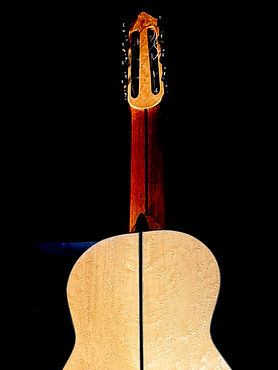
All photos are No.65
The top is made of cedar wood that had been submerged in a lake for 10 years. The back and sides are made of birdseye maple, which is not often used in classical guitars. It is extremely rare and beautiful.

The handmade rosette is made of 0.5mm square lumber. It is a very difficult task, but this is where the craftsman's face shines.

The combination of a raised fingerboard with a fairly steep angle and a sound port is a characteristic of Obana's current guitars.

The headstock has a very beautiful shape. All the pegs are made by VS Tuners in Brazil and are custom made for 8-string guitars.


About OBANA Microfone
OBANA Microfone is a microphone manufacturer that began with the birth of a dynamic microphone specifically for classical guitar, which was developed through extensive research and refinement by eight-string guitarist Takeshi Obana for use in his own live performances. Now in its fifth generation, the company manufactures and sells compact microphones that embody the desire of musicians to "deliver the raw sound of their instruments directly from the PA system," including a model specifically for the pandeiro and a model that can be attached to the DPA 4099 instrument holder.
The OBA-G5 dynamic guitar microphone is able to output a natural, seamless sound from the PA, making it popular even among classical guitarists who would prefer not to use a microphone if possible.
It also has relatively high resistance to feedback even in loud monitoring environments, making it popular in jazz and pop settings where drums and bass are added.
One particularly unique item in the lineup is a microphone specifically designed for the pandeiro, a percussion instrument that originated in Brazil. This model is a favorite among top players in Brazil. It is no exaggeration to say that the OBA-PD2 is the only microphone in the world that can be fitted specifically to the pandeiro.
Please click on the photo on the right.
Go to the official OBANA Microfone sales site.
You can get your hands on the Obana microphone now.

OBA-G5

OBA-U1

OBA-ARM

OBA-Headset

OBA-PD2

OBA-GC2
